What is a vision board and why you need one in 2026
Okay, real talk. Have you ever been scrolling Pinterest and stumbled across someone’s aesthetic collage full of travel photos, dream apartments, and motivational quotes and thought “wait, what even is this?”
That, my friend, is a Vision Board. And once you understand what it actually does, you’re going to want to make one immediately.
So, what exactly is a Vision Board?
A Vision Board, also called a dream board, visualization board, or dream map, is basically a visual representation of the life you want to build.
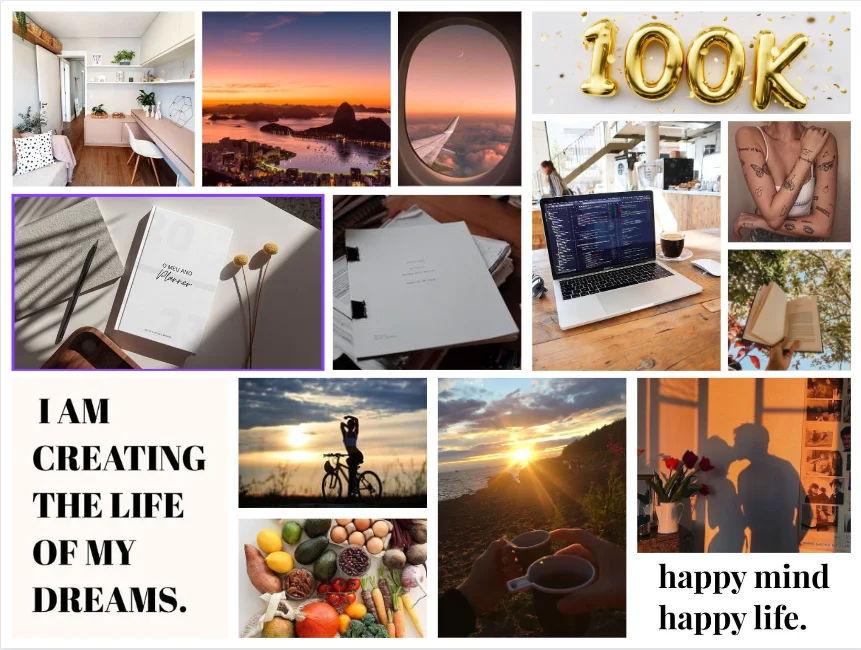
It’s a collage of images, words, phrases, and symbols that represent your goals, dreams, and desires. It can be physical (think scissors, magazines, and a cork board) or fully digital. Both work. What matters is that it’s yours and it actually means something to you.
The idea is simple: when you can see your dreams clearly, you’re much more likely to work toward them. Your goals stop feeling abstract and start feeling real and achievable.
Is this just a manifestation thing?
Kind of, but it’s also so much more practical than people give it credit for.
Yes, a Vision Board is connected to the Law of Attraction, which is basically the idea that what you focus your energy and attention on, you start to attract into your life. By regularly visualizing your goals, you’re sending a clear signal, to yourself and to the universe, about what you’re working toward.
But here’s what I actually think makes it powerful: it forces you to get specific about what you want. You can’t put something on your Vision Board if you haven’t decided you want it. That clarity alone is worth the exercise.
The Law of Attraction works best when you pair it with real action, and a Vision Board helps you do exactly that.
How does a vision board help with personal planning?
This is where it gets really good. A Vision Board isn’t just a pretty collage. It’s actually a legit personal planning tool.
Here’s why it works so well:
It keeps your goals visible. Out of sight, out of mind is real. When your dreams are literally in front of you every day, you think about them more and you make better decisions that align with them.
It keeps you motivated. On the days when you’re tired and nothing feels worth the effort, looking at your Vision Board reminds you why you started.
It helps you prioritize. Deciding what goes on your board is a reflection exercise. You figure out what actually matters to you and what’s just noise.
💡How to set personal goals and actually achieve them in 2026
What Should You Put on Your Vision Board?
This is the fun part. There are no rules, but here are some ideas to get you started:
- Your goals across different time frames. Short-term (this year), medium-term (next 2 to 3 years), and long-term (your big life dreams). Break them down and find images that represent each stage.
- Different areas of your life. Career, health, relationships, finances, travel, personal growth. A balanced Vision Board reflects a balanced life.
- Words and affirmations. Choose phrases that genuinely resonate with you. Not just generic motivational quotes, but words that feel like you and your specific goals.
- Symbols and images that just feel right. Sometimes a photo speaks to you and you don’t even know exactly why. Trust that. If it gives you a feeling, it belongs on your board.
The most important thing: every element should be intentional. Don’t just throw things on there because they look pretty. Ask yourself: does this represent something I actually want?
How to make your Vision Board, step by step
Step 1: Get clear on your goals first
Before you touch a single image, sit with your goals. What do you want your life to look like? What areas need the most attention right now? The Wheel of Life is a great tool for this. It helps you see which areas are thriving and which ones need some love.
Step 2: Decide on your format
Digital or physical? Both are great. Physical boards are tangible and satisfying to make. Digital ones are easier to update and can live on your phone or computer wallpaper.
If you go digital, save it as your lock screen or desktop background somewhere you’ll actually see it every day.
Step 3: Gather your materials
For physical boards: magazines, printed photos, scissors, glue, a board or journal page. For digital boards: Pinterest, Canva, or even a simple Google Slides doc works perfectly.
Step 4: Build it
Lay everything out, arrange it until it feels right, and fill the space. Don’t overthink this part. Go with what feels good and meaningful to you.
Step 5: Put it somewhere you’ll actually see it
This is the most important step and the one people skip. A Vision Board that lives in a drawer does nothing. Put it on your wall, your desk, your phone screen, somewhere it’s part of your daily life.
And then spend a few minutes with it every day. Look at it. Really look at it. Let yourself feel connected to those goals.
Best tools to create your digital Vision Board
If you want to go the digital route, here are my favorites:
- Pinterest is honestly the most natural place to build a Vision Board. Create a private board, start saving images that speak to your goals, and watch it come together. Plus you’ll find so much inspo from other people’s boards.
- Canva is perfect if you want something more polished and designed. They have Vision Board templates you can customize completely, fonts, colors, layout, everything.
- MindMeister is a great option if you’re more of a mind map person and want to organize your Vision Board by categories with branches and notes. Really cool for visual thinkers.
One more thing: write it down yoo
A Vision Board is powerful for the visual side of goal setting. But pairing it with a space to actually write your goals, track your progress, and plan your actions? That’s where the magic really happens.
That’s exactly what our digital notebooks at Planner Love Club are designed for: a beautiful, organized space on your tablet where your planning actually feels good to do.
👉 Check out our digital notebooks here and start planning the life on your Vision Board. 🩷